
Water Damage Inspection for Affected Areas in Charlotte & Concord, NC
A water damage inspection answers three questions: where did the water go, which materials are wet, and what has to happen next. Phantom Restoration provides water damage inspections in Charlotte & Concord, NC after leaks, burst pipes, appliance failures, storm water and floods, and when you suspect a problem you can't see yet. The inspection is the assessment. Any work that follows, such as water extraction or drying, is a separate step that the inspection helps us define.
When you call, we ask what you know: where the water came from, when you found it, what's visible and whether it's safe to get in. We answer 24/7 and send a crew as soon as we can. Typical starting points here are a crawl space under an older house, a ceiling stain after a storm or a leak upstairs, a room near a pipe that froze in winter and a damp spot in a humid summer that nobody can explain. The full job that follows an inspection is water damage restoration, from removing standing water through drying and documentation.
Before we arrive, and only if it's safe, shut off the water at the valve, lift small items and furniture out of the wet area and take photos of the damage before anything else is moved. Those photos show what the water did before anyone cleaned up.
Start With the Event History and Immediate Hazards
We start with the story of the loss, because it tells us where to look. We ask when the water was found, what the source is if you know it, which rooms are involved and whether any water is near outlets, appliances or other electrical equipment. We also ask whether there's any chance the water came from a sewer backup, since that changes how we work.
Safety comes before the inspection. The CDC advises against entering standing water to switch off power, and an electrician may be needed to make the area safe. Don't walk through water to reach a breaker or a switch. If you can't tell whether the power is safe, tell us when you call. If sewage may be involved, stay out of the area and keep children and pets away. A sewer backup is a sewage cleanup job, handled with protective measures and a different process from a clean-water loss.
Inspect Visible Damage and Adjacent Materials
Next we look at what can be seen and at what is next to it. We check flooring, the base of walls, ceilings, cabinets and the spaces beside the affected room, because water seldom stays where it first landed. In a crawl space, we look at the subfloor from below, the joists, the insulation and the ground.
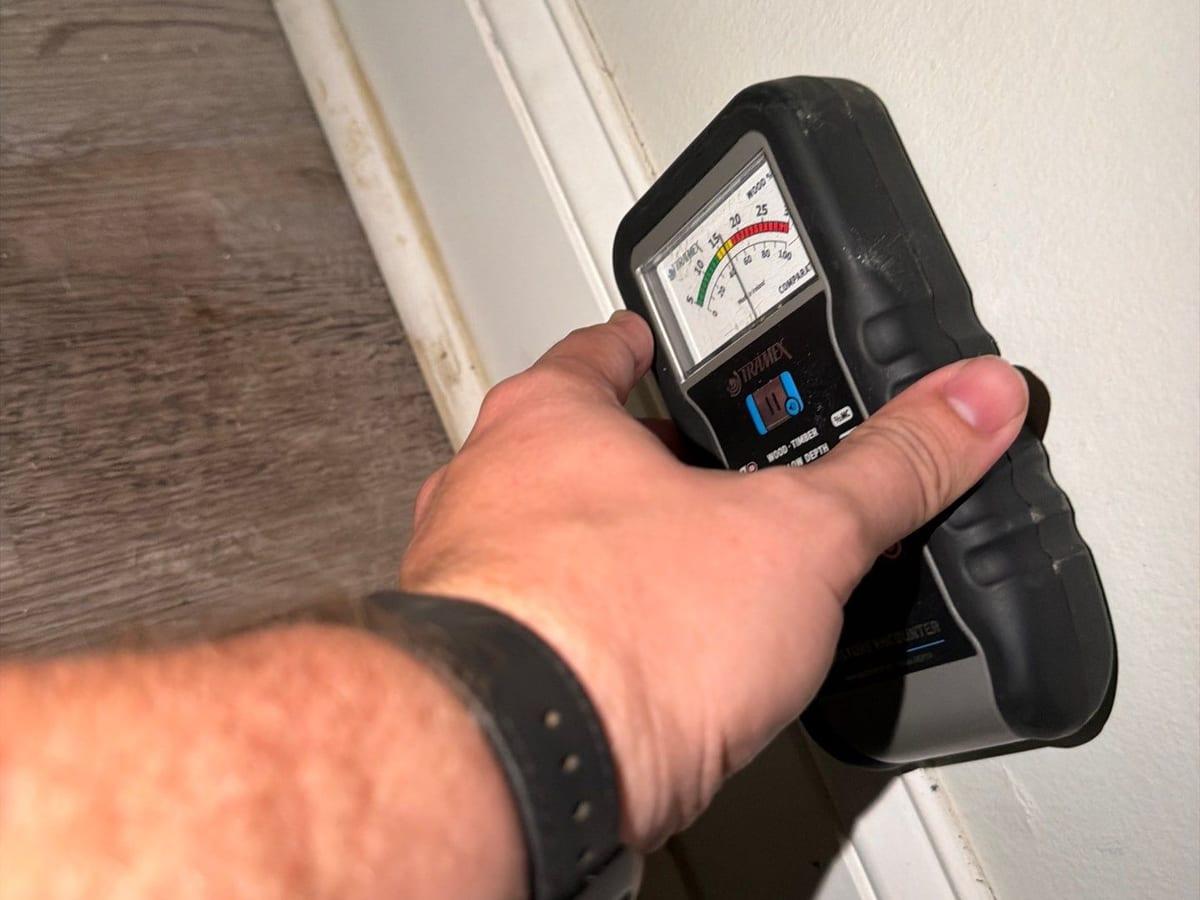
We don't claim to check every concealed cavity without opening anything. What we can check without opening walls, we check with moisture meters, taking readings at marked locations so we can find the same spots again. Where the readings or the damage point to a hidden cavity, we tell you and recommend opening it. Opening a wall, floor or ceiling is done with your permission, and only where the evidence calls for it.
Thermal Imaging in a Water Damage Inspection: What It Can and Cannot Show
One of the tools we use in an inspection is a thermal imaging camera. It reads surface temperatures and shows them as a picture, and a wet area can show up as a temperature difference from the dry area around it. That makes it useful for deciding where to take moisture readings, especially when there's no stain or the stain looks smaller than the damage.
A thermal scan may help when you have an unexplained stain, a wall or floor near a known water event or a question about an area after cleanup. It guides where we test next. It is not a remote diagnosis.
It also has limits, and you should know them. A thermal camera doesn't see through a wall. It doesn't measure moisture by itself, it can't prove mold and it can't promise to show the source of a leak. Temperature differences have other causes, such as gaps in insulation, sunlight on an outside wall or pipes and vents behind a surface. So we confirm anything suspicious with a moisture meter before we say a material is wet.
We ask about surface access and recent conditions before we scan, since both change what a thermal image shows. A scan isn't needed in every case. For some losses, a meter and a careful look are enough.
Document Moisture Evidence and Its Limits
We document what we find with photos and moisture readings, noted by location, so every reading can be found again. We keep three things separate: the source you've told us about, the damage we can see and the conditions we haven't been able to confirm. A moisture reading tells us that a material is wet. On its own, it doesn't tell us which pipe failed or where. We also note what each material is, because the same reading means different things in drywall, wood and concrete, and we compare wet areas with dry areas of the same material in the same building.
If we couldn't reach an area, the record says so. We would rather mark a space as not checked than leave you thinking it was.
Hidden Leak Clues and Finding the Source of Moisture
Sometimes there's no event, only a clue: a stain that appeared on a ceiling, a damp spot on a floor, a musty smell or a water bill that has gone up. Common clues include a water-meter reading that changes when every fixture is off, a damp area that keeps coming back and water use that continues when nothing is running. None of these tells you which part failed or where. Stains and dampness can have more than one cause, so we don't assume.
When you call about a clue, we ask about fixture use, any change in your meter or your bill, where the damp area is, when you first noticed it and whether water is running now. During an inspection, we use thermal imaging and moisture meters to find where the moisture is, which helps narrow down where the water has traveled and where it may have started. That is the extent of it. We don't repair a pipe, and we can't promise to pinpoint a hidden leak.
A plumber fixes the pipe; we handle the water and the drying. If the clues point to a pipe under a slab or in a buried line, that is a job for a plumber or a specialist, and we don't locate those. If you think water is running now, shut it off at the valve if it's safe to reach, and call us.
Turn Findings Into a Proposed Next Scope
An inspection ends with a plain explanation of what we found and what we recommend. Depending on the findings, that might be water extraction if there's standing water, structural drying if materials are wet, removal of materials that can't be dried or a plumber if a source still has to be fixed. It might be none of these. Not every inspection leads to water mitigation, and we won't recommend work the readings don't support.
If the findings call for work, we explain what we would do, in what order, and why. You decide whether to go ahead. The inspection tells you what is wet and what is dry, so that decision rests on readings and not on a guess.
Explain Records Without Promising Claim Approval
We work with all insurance companies. We document the damage with photos, moisture readings and drying records and share them with your adjuster. Your policy and your insurance company decide what's covered.
No one who inspects your property can promise that a claim will be approved or paid, and we don't. What our record does is show what we found, where we found it and what we recommend. Keep your own photos and any notes about when you first saw the damage, since they help alongside ours.
Schedule a Water Damage Inspection in Charlotte & Concord, NC
To schedule a water damage inspection, call (980) 501-1879. We answer 24/7 and send a crew as soon as we can. Tell us what you know: the source if you have one, which rooms are affected, when you found the water and anything that makes access difficult or unsafe. An inspection defines what we can see and measure, and what comes next. If it isn't urgent, you can also reach us through our contact page. We serve Charlotte & Concord, NC and the surrounding area.