
Remove Standing Water and Assess Crawl Space Flooding in Charlotte & Concord, NC
Crawl spaces are where we started. Phantom Restoration began in 2022 with work under houses, and what we kept finding down there was moisture. Moisture turned into mold, so we trained in mold remediation, and mold kept leading us back to water. That is why we look at what's under your floor as carefully as what's on top of it.
Many homes in the Charlotte region sit on crawl spaces, and the space under the floor is easy to ignore until something goes wrong. You might see water through the access door, smell damp air in the house or notice a soft spot in the floor. Water under a house could have come from rain, from the ground, from a pipe or from a drain that backed up, and you can't always tell which from where you're standing. So the first job is to work out where it came from and whether it's safe to go in. Only then do we remove the water. If you're looking at water under your house now, call (980) 501-1879. We answer 24/7 and send a crew as soon as we can.
The steps are the same as in any water damage restoration: find the source, remove the water, dry what it reached. Under a house, a low, tight space and the wiring running through it change how we do each one.
Identify the Source Before Selecting Cleanup
The source decides how we get in and what the cleanup looks like, so it's the first thing we ask about. Did rain come in through the vents or across the ground? Does the soil slope toward the house, or do downspouts empty next to the foundation? Has the ground stayed soaked after a long rain? Is a supply line under the house leaking, or did a sewer line back up? A winter freeze can split a supply line under a house too, which makes it a burst pipe cleanup as well as a crawl space job.
Our red-clay soil drains slowly, so after a summer thunderstorm or the remains of a tropical storm, water can sit around a foundation for a long time. Humid summers add moisture to the air under the house even when nothing is flooding. If a sump pit under the house has stopped working, the water is handled much as it is in basement flooding after a sump pump failure: a pump professional fixes the pump, and we handle the water and the drying.
Don't call every under-house event clean water. The CDC says floodwater can carry waste, chemicals, germs and debris. If you think a sewer line has backed up, that is a sewage cleanup job, and we treat the water as contaminated. Write down when it rained, where the water first showed up and whether it's still there. We don't diagnose a foundation problem from a single visit, and you shouldn't expect us to.
Plan Safe Access and Water Removal
A crawl space is low and tight, and wiring, ducts and pipes often run through it. Water makes every one of those worse. Please don't climb into a crawl space that has water in it, especially if you're unsure about the wiring or whether the water is contaminated. Look through the access door from a safe spot if you can, and take photos.
Once we know what we're dealing with, we decide how to get in and what has to happen first. Wiring in the water, or water that might be contaminated, changes that plan. Where we can safely reach the water, water extraction starts at the deepest point, using extraction equipment.
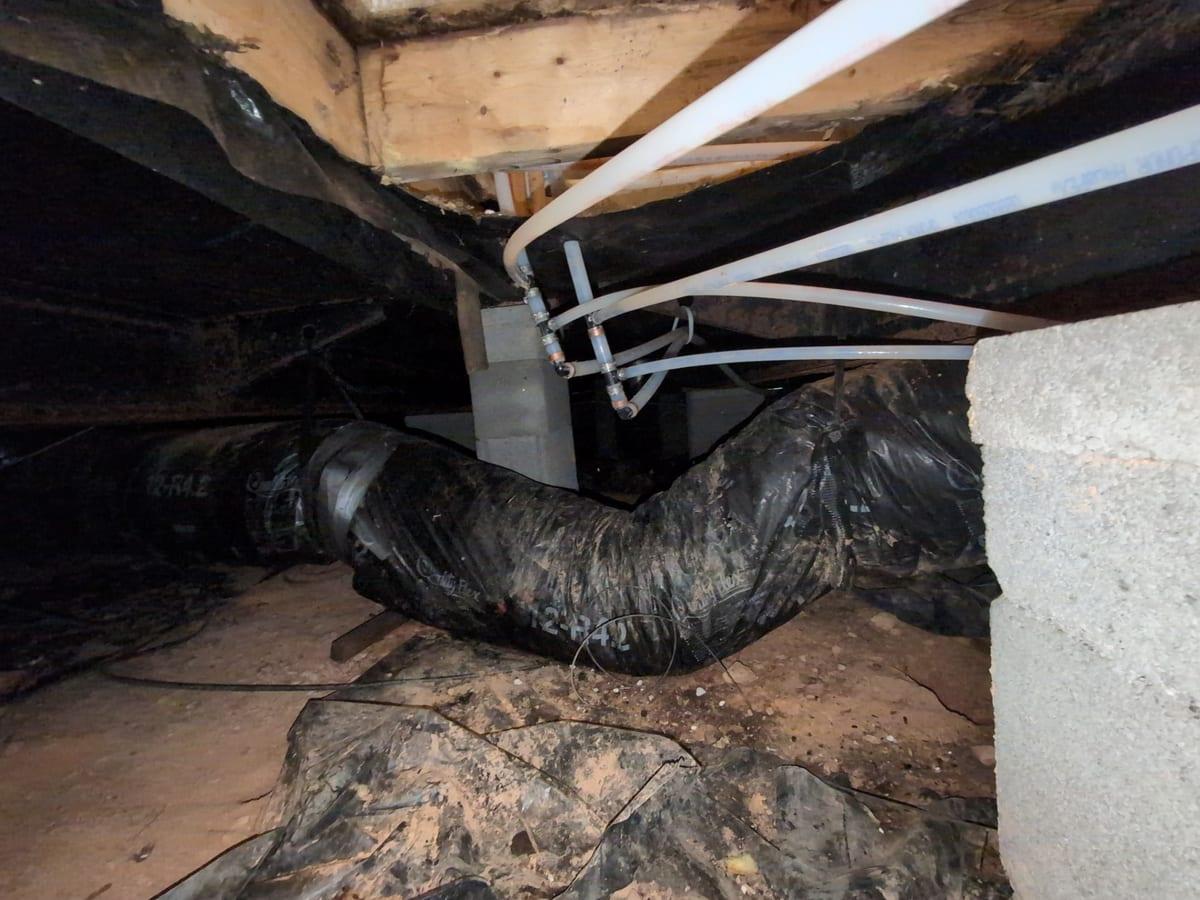
With the standing water out, we look at what's under the house: the ground, any vapor barrier already in place, the floor joists, the underside of the subfloor, the insulation, and the plumbing and ductwork that pass through the space. That is an assessment of what the water touched and how wet it is.
Check Wet Underfloor Materials
Insulation and wood are the first things water reaches under a floor. For each one we ask the same question: can it be reached, cleaned and dried, or does it have to come out? EPA's flood guidance says to throw away materials that soak up a lot of water and can't be cleaned and dried. Wet insulation is a common example, because it holds water against the wood above it. We tear out insulation that can't be dried so it stops holding moisture against the joists.
Joists and the underside of the subfloor are wood, and wood is often dried in place rather than removed, depending on how long it was wet and what the water carried. We use moisture meters and thermal imaging cameras to find where the moisture is, set air movers and dehumidifiers, and go back to the same spots to take readings until the wood is dry. That repeat-reading routine is structural drying, and it's how we know the wood is dry rather than guessing. If you're not sure how far the water went, a water damage inspection is how we check the wood, insulation and floor above for moisture you can't see.
If water has been under the house long enough for growth to start, we also offer a free mold inspection. We look for visible growth and check moisture. If there is mold in the crawl space itself, removing it is crawl space mold removal, a separate job from the water work.
Separate Drying From Drainage or Structural Repair
Drying a crawl space deals with the water that is already there. It doesn't change what let the water in, and if that is still happening, the space will get wet again. The usual causes around here are ground that slopes toward the house, downspouts that empty at the foundation, red-clay soil that holds water against the house, groundwater after a long rain, a leaking line under the floor, and humid summer air moving through the vents. Cleanup and drying don't prevent a repeat, and we won't tell you they do.
Different problems have different people. A plumber fixes the pipe; we handle the water and the drying. A qualified drainage or foundation specialist can evaluate grading, drains and groundwater that keeps coming back, and a qualified structural professional can assess damaged framing. Stopping the water from returning is their job, not part of cleanup and drying.
What we can do is tell you what we see. We'll show you what's feeding the moisture, with photos and readings, so you know what to ask the specialist and what to watch for after the next storm.
Ask About Crawl Space Flooding in Charlotte & Concord, NC
If you've found water under your house, call (980) 501-1879. We answer 24/7 and send a crew as soon as we can. Tell us how deep the water is if you can see it, when it last rained, whether you've noticed a plumbing leak, how you get into the crawl space, and whether you think wiring or sewage may be involved. Please don't crawl in to find out. After we inspect, we give you a written scope of the work.