
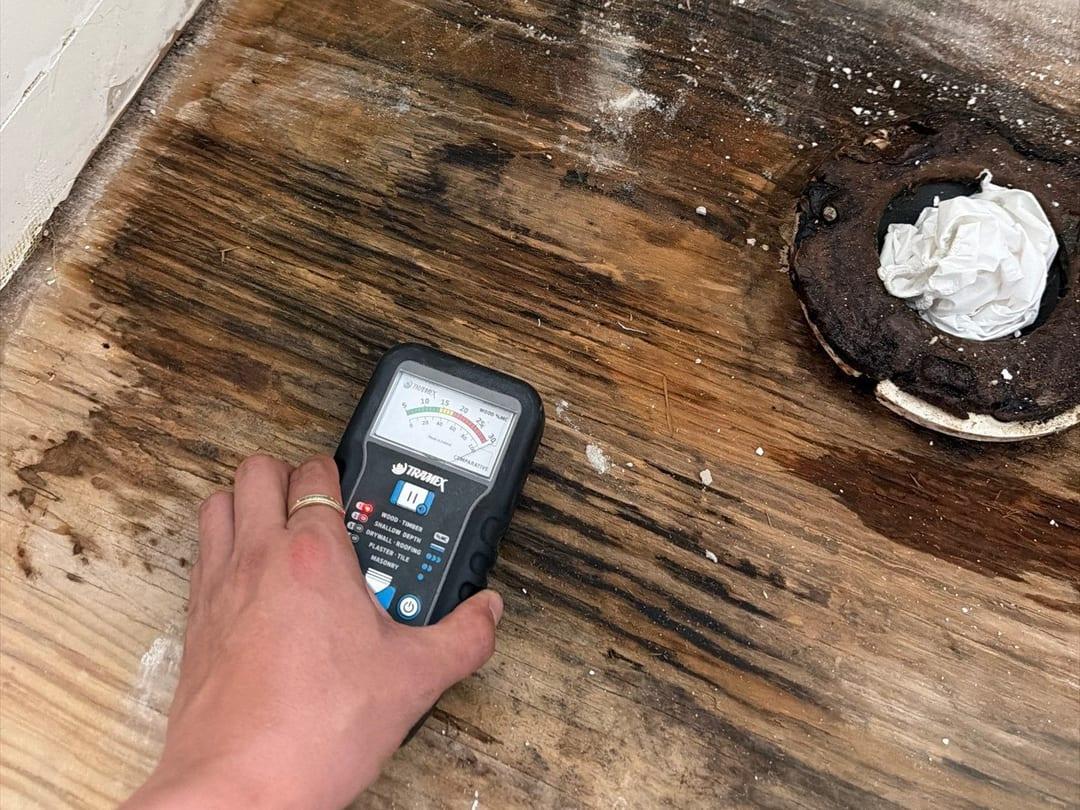
Hardwood Floor Water Damage in Charlotte & Concord, NC: Evaluate Boards and Subfloor
A wet hardwood floor can look fine on the surface and still hold water underneath. Cupped edges, boards that have started to lift, gaps at the seams, a cloudy finish or a floor that feels soft in spots are signs that the wood has taken on water. The source of that water, the kind of floor and the layers beneath it decide what happens next. The National Wood Flooring Association (NWFA) explains that wood responds to moisture and can cup when it gets wet, which is why we look at the whole floor assembly and not only the boards you walk on.
In the Charlotte region, floors take on water in several ways: an appliance or supply-line leak, a burst pipe after a winter freeze, storm water that gets in during a summer thunderstorm or after tropical-storm remnants, and moisture from a wet crawl space below. Many homes here sit over crawl spaces, and crawl spaces are where we started, so we think about what is under the floor as well as what is on it. Humid summers matter too. Wood responds to humidity, and a floor that is already damp dries more slowly.
Call us at (980) 501-1879. We answer 24/7 and send a crew as soon as we can. We dry the floor and what's under it. We don't promise that cupping will reverse or that a floor can always be saved, and we tell you so before we start.
Make Sure the Water Source Is Stopped and Remove Pooled Water
The first question is whether the water is still coming in. A floor can't dry while a leak is still wetting it, and a drying plan built around the boards alone will fail if a pipe or an appliance is still running underneath. A plumber fixes the source; we remove the standing water and dry what it reached. Tell us whether the water has been shut off, because it changes the plan.
Standing water comes off first. We remove it with extraction equipment, working across the floor and along the edges where water collects against baseboards and under cabinets. Water extraction goes room by room, starting where the water is deepest. On a hardwood floor, getting the water off matters for a simple reason: the longer it sits on the boards, the more of it works into the seams and down toward the subfloor.
Assess Wood, Finish, and Subfloor Separately
We treat the wood, the finish and the subfloor as three separate questions. On the wood, we note swelling, cupping, soft or loose boards and gaps at the seams. Boards that feel soft underfoot, shift when you step on them or have started to lift at the edges tell us the layers under them may be wet too. A changed finish, such as white clouding or dull patches, tells us the surface has been wet. It doesn't tell us how wet the board or the layers below have become, so we don't judge the whole assembly from the finish.
Solid wood and engineered wood react differently to water, and so do different finishes, so we start from the readings on your floor instead of assuming. We use moisture meters on the boards and, where we can reach it, on the subfloor. If your home sits over a crawl space, the underside of the subfloor is often reachable from below, which can tell us things the surface of the floor can't. A floor can be dry at the surface and wet underneath.
We don't claim to identify every wood species or floor product from the surface. We tell you what the readings show, what we can dry and what looks unlikely to dry.
Track Moisture Before a Dry-or-Replace Decision
Wood dries slowly and unevenly, so one reading on one day settles nothing. We take material-specific readings at marked spots on the floor and the subfloor and return to the same spots on each visit, so you can see whether the numbers are going down. Because wood responds to moisture, as NWFA explains, a floor that has taken on water needs time and follow-up readings before anyone judges it. We don't work to a universal time or a universal number.
We use air movers and dehumidifiers to dry the room and the floor assembly, and moisture meters to check progress. In humid weather the dehumidifiers matter as much as the air movers, because blowing humid air across a floor doesn't pull moisture out of the wood. Where the wet area reaches beyond the floor into walls or cavities, structural drying covers the whole assembly, with readings in the walls as well as the boards. If moisture may have gone beyond the visible boards, a water damage inspection checks the nearby materials with moisture meters.
Cupping is a sign of a moisture imbalance in the wood. It is not a verdict on the floor. Some floors flatten as they dry, and some don't. Some boards can't be dried at all. The decision between drying and replacing comes after the readings. If the floor does need replacing, we can handle the replacement, or work with your flooring contractor.
Consider Source Water and Material Condition
Where the water came from changes the plan. A clean supply-line or appliance leak is one situation. Floodwater or sewage is another, because CDC guidance on flood and sewage cleanup treats that water as contaminated and the porous materials it soaked as items that may need to be removed. When the water is contaminated, the boards, the underlayment and the subfloor beneath them are assessed as contaminated material, and some of it may have to come out.
We don't promise a floor can be saved in either case. If the water was sewage, it's a sewage cleanup job, handled as contaminated water from the start. If you're not sure where the water came from, tell us what you know, including where it first appeared and what it looked and smelled like, and we'll treat it cautiously until we do.
What Happens When the Floor Is Dry
If boards have to come out so the subfloor can dry, we remove them as part of the drying. That is tear-out, not replacement. Whether the remaining floor can be left as it is, sanded and refinished, or replaced is your decision, made once the readings show the floor and subfloor are dry.
Once everything is dry and documented, repairs can begin. We give you the drying records your adjuster needs, and we can also handle repairs such as drywall, flooring and cabinets. If you already have a contractor, we'll give them the drying records and work alongside them. Those records show the starting readings, the readings from each visit and the point where the floor and subfloor read dry, so whoever works on the floor next can see what it went through before anyone picks a next step.
We work with all insurance companies. We document the damage with photos, moisture readings and drying records and share them with your adjuster. Your policy and your insurance company decide what's covered.
Ask About Hardwood Floor Water Damage in Charlotte & Concord, NC
If your hardwood floor has been wet, call (980) 501-1879. We answer 24/7 and send a crew as soon as we can. Tell us where the water came from, how long the floor was exposed, whether any standing water is left, what kind of floor you have if you know, what has changed in the boards and which rooms are affected.
Whether a floor can be saved is an assessment, not a promise, and we won't make one before we've looked. We give you a written scope after we inspect. A wet hardwood floor follows the same water damage restoration process as any other water loss, from the first call to the drying records.