
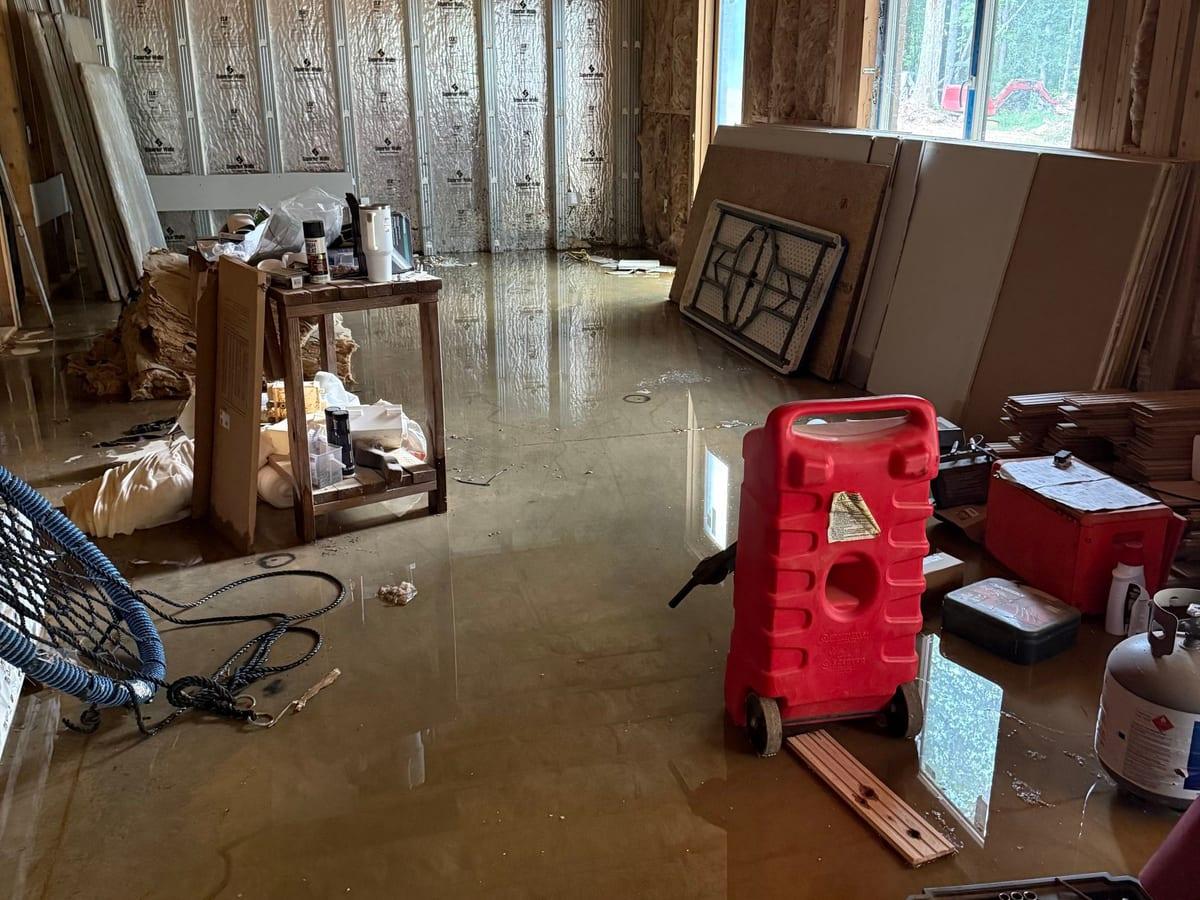
Assess Basement Flooding in Charlotte & Concord, NC Before Cleanup
Not every house here has a basement. They're mainly in older homes and homes on sloped lots, and when they flood, it's usually after a summer thunderstorm, the remains of a tropical storm or a long soaking rain on red-clay soil that drains slowly. Water finds its way in through the floor, the walls or a window well. If your home has a basement and it has taken on water, call (980) 501-1879. We answer 24/7 and send a crew as soon as we can.
Before anything else, we'll ask where the water came in, whether it's still rising, what electrical equipment is near it, and whether you smell sewage or see a drain backing up. That call gives us what we need to plan the work. It isn't a safety clearance for the space, and we won't tell you a flooded basement is safe to enter. Once we're on site, the steps are the same as in any water damage restoration job. Below ground, a few things change: power, a sump pump and the drains all come into play.
Separate Surface Water, Plumbing, Sump, and Sewer Sources
A flooded basement can have four different causes, and each one changes the cleanup. Surface water comes in from outside after heavy rain. A plumbing source is a supply line, a water heater or an appliance that has let go. A sump source means the pump that normally keeps groundwater out has stopped or can't keep up. A sewer source is a floor drain or sewer line that has backed up into the house.
No single cause explains every flooded basement, and you often can't tell by looking. Don't assume unknown water is clean. The CDC says floodwater can carry waste, chemicals, germs and debris, and if your home is on a septic system, EPA has separate guidance for after a flood. If a drain has backed up or you smell sewage, treat it as a sewage loss; sewage cleanup starts with treating the water as contaminated. If the water came from a wider flood, the job is flood damage restoration across everything the water reached, not just the basement.
A few clues help us sort it out, and you can gather them without going near the water. Did it show up during or just after heavy rain, or on a dry day? Did it start where the wall meets the floor, at a drain, near the water heater or an appliance, or come through the ceiling? Is it clear, cloudy or dirty, and does it smell? Take photos from a safe spot and write down when you first noticed it. None of this is a diagnosis, but it saves time when we start.
Knowing the source matters for another reason. We handle the water and the drying. Whatever let the water in has to be fixed by someone else, and who that is depends on the source.
When a Sump Pump Fails: What Cleanup Covers and What a Pump Professional Fixes
When a sump pump fails or can't keep up during heavy rain, the pit fills and water spreads across the basement floor and into the base of the walls. A sump pump failure alarm means the water in the pit is rising faster than it's being pumped out, so treat an alarm as a warning that water is about to come in, or already has.
When you call, we'll ask whether the pump has power, whether an alarm sounded, whether water is still coming in and how far it has spread. We won't try to diagnose the pump from a phone call or a web page, and you shouldn't step into water to reset a pump or a breaker.
Cleanup and pump repair are different jobs. A pump or plumbing professional fixes the pump. We handle the water and the drying: we remove the water, check the floor, the base of the walls and your belongings, and dry what stays. If the pit is still overflowing, the plan has to account for the water that keeps coming. Some homes have the sump pit in the crawl space instead, which makes it crawl space flooding; the split is the same, with the pump fixed by a professional and the water handled by us.
Check Electrical Access Before Entering Standing Water
Water and electricity are the first danger in a flooded basement. Don't walk into standing water to reach a power switch or breaker, and don't use electrical tools, extension cords or appliances in the wet area. The CDC advises calling an electrician if you can't reach the main switch from a dry spot, and that is the right call. If you can't tell whether the power is on, treat it as on.
This is a safety handoff, not something we do. We don't do electrical work, and we won't say a basement is safe to enter. Once the power is off, or an electrician has made the area safe, we can start removing water.
Remove Water and Assess Finished-Basement Materials
We start by mapping how deep the water got and which parts of the basement it reached, then we remove it with extraction equipment. Water extraction goes area by area, starting where the water is deepest.
Then we go through what the water touched: carpet and pad, drywall, insulation, cabinets, stored belongings, and the base of the walls and the floor. Some of it can be cleaned and dried, and some of it can't. The CDC says porous materials that floodwater or sewage has contaminated, along with anything absorbent that can't be cleaned and dried, should be thrown away. We decide material by material, based on what the water was and how long it sat, and we'll show you the readings behind each call. We don't promise that a finished basement can be saved. Wet insulation and drywall at the bottom of a wall can hide moisture, so we check inside the wall with moisture meters and thermal imaging cameras and not only the surface.
Stored belongings get their own look. We can pack them out of the wet area and pack them back in when the work is done. We don't restore contents ourselves, so if an item needs a specialist, we'll tell you.
Plan Drying and the Source-Repair Handoff
An empty basement can still be wet. Even after the standing water is gone, the walls, the floor and the spaces inside them can hold moisture. We take readings with moisture meters and thermal imaging cameras, set air movers and dehumidifiers, and keep taking readings until the materials are dry. That is structural drying, and it covers the spaces inside walls and floors, not just the surface you see. A dehumidifier on its own won't dry a flooded basement. The standing water has to come out first, and a dehumidifier can't stop water that is still coming in or fix a failed pump or pipe.
EPA says drying can take a long time, usually several days to weeks, and that mold can grow on wet materials that stay wet for more than 24 hours. That is why we go by readings and don't promise a fixed number of days. If you see dark growth or smell something musty afterward, we offer a free mold inspection. We look for visible growth and check moisture.
The handoff has two parts. First, the source needs a fix. A plumber fixes the pipe; we handle the water and the drying. A pump professional handles the sump, and if water keeps coming in from outside, a drainage contractor or a foundation professional can look at why. We'll show you what we found so you know what to tell them. Second, once everything is dry and documented, repairs can begin. We give you the drying records your adjuster needs, and we can also handle repairs such as drywall, flooring and cabinets. If you already have a contractor, we'll give them the drying records and work alongside them. We can't promise that a future storm or failure won't cause another loss.
Request Help for the Flooded Basement
Call (980) 501-1879. We answer 24/7 and send a crew as soon as we can. Tell us how deep the water is if you know, where it came in, whether it's still coming in, what you saw at the sump or the floor drain, and which finished areas are wet. If you don't know, say so. After we inspect, we give you a written scope of the work.