
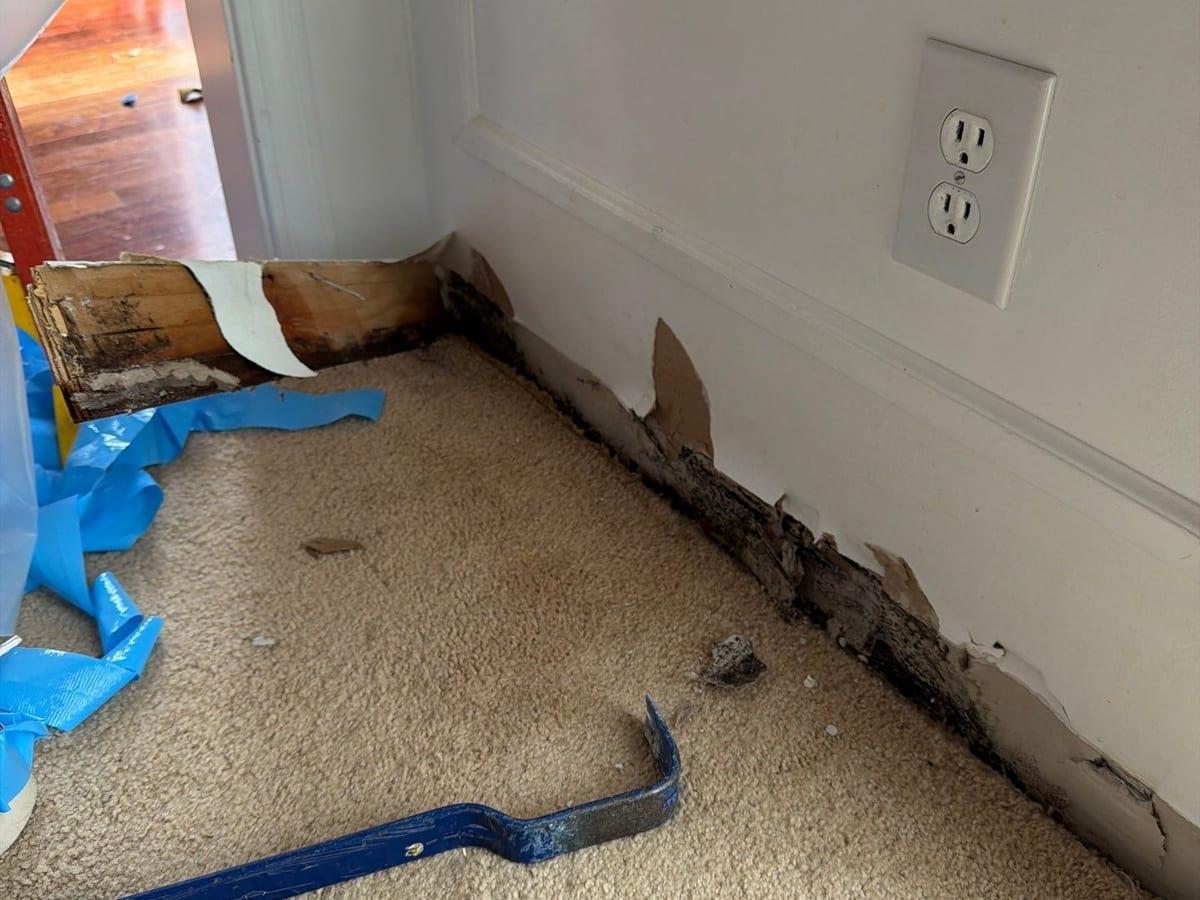
Mold Inspection to Trace Moisture and Define Next Steps in Charlotte & Concord, NC
A mold inspection is how you find out what you're dealing with. Our mold inspection is free. We look for visible growth and check moisture. The goal is to answer three questions: where is the moisture coming from, which materials are affected, and what is the next step?
If you're in Charlotte, Concord or the surrounding area and you've seen spotting, smelled mustiness, or had water in the house, an inspection tells you whether you have a mold problem, a moisture problem, or both. In this region the usual starting points are a damp crawl space, a leak that dried slowly, or storm water. Mold needs moisture to grow, so the moisture is where we look first.
A few things are worth doing before we look. Leave suspected mold alone, because scrubbing or sanding can spread it. Note where you've seen it and when the last leak, flood or storm-water event happened. If you can do it safely, take photos before anything changes. Tell us about past water damage, even if it was dried out and looked fine, because old water events are often where mold starts.
The same team inspects and removes mold. If you or your insurance company want independent testing, a third-party assessor can do it.
When You Should Schedule a Mold Inspection
Schedule an inspection if you smell mustiness that doesn't go away, see spotting on walls, ceilings or trim, notice condensation on windows or pipes, or have had recent water damage. Damp materials in a crawl space or attic are another reason to look, and so is dampness in a basement if your home has one. A musty smell in the upstairs rooms of a house on a crawl space often starts under the floor.
Mold can start wherever materials stay wet, and the longer something stays damp, the more likely growth becomes. That's why a leak you fixed last month or a storm-water event you thought you'd dried out is still worth a look if the smell or the staining shows up afterward.
These observations justify a closer look. They don't diagnose mold, and they don't explain anyone's symptoms. If you have health concerns, keep them with a health professional.
What a Mold Inspection Includes
Our free mold inspection is a visual and moisture check. We look for visible growth and we check moisture. The inspection and our visual findings are free. Testing and surface samples are charged separately, and we give you the price before any sampling is done. The three parts below explain what each of those means, where an inspection reaches its limits, and how what we find turns into a plan.
Visual and Moisture Assessment
We look at what's visible: spotting on walls, ceilings, trim and framing, staining, soft or damp materials, and signs of past water. We check moisture, because mold needs a moisture source. Where we find dampness, we try to trace it back to a source such as a plumbing leak, a roof leak, condensation, ground moisture or storm water. We also separate what we can see from what we only suspect. Visible mold is an observed condition. A musty smell with nothing visible is a suspicion, and we'll tell you which one you have.
Affected Materials and Access Limits
An inspection covers what can be reached and seen. Wall cavities, the space above a ceiling and the area under a floor can't be seen without opening them. If moisture history, smell or staining points to a hidden area, the next step may be a small, controlled opening, done with your OK and a plan for the dust. Moisture meters and thermal imaging cameras can point to damp material behind a surface, but neither one shows mold on its own. Which tools make sense depends on the home and what we find. Where an inspection can't reach, we say so rather than guess.
Findings, Sampling Decisions, and Next Steps
What we find shapes the plan: which materials are affected, how large the area is and what's feeding the moisture. Sampling is a separate decision. EPA says sampling is usually unnecessary when mold is visible and the cleanup plan is clear. It can be useful when it would change a decision, such as an unclear source or a specific question you need answered. We'll tell you whether sampling would help in your case, and if it does, mold testing sends the samples to an independent third-party lab for analysis. If you want work done, we give you a written scope after we inspect, so you can see what's involved before you decide.
Mold Inspection vs. Mold Testing
An inspection looks at conditions: visible growth, moisture and the materials involved. Testing is different. It collects samples, such as air or surface samples, for lab analysis, and it answers narrower questions, such as what type of mold is present. Testing can't tell you why an area is wet, and an inspection can't tell you the type of mold. Visible mold usually still needs source control and cleanup, whatever a sample shows. Many inspections end without any sampling, because the visible growth and the moisture picture are enough to plan the work.
The same team inspects and removes mold. When we take samples, an independent third-party lab analyzes them. If you or your insurance company want independent testing, a third-party assessor can do it.
What Happens After Mold Is Found
If we find mold, we tell you what it is, where it is and what's feeding it. Then the next step depends on the source and the location.
Visible mold on walls, ceilings, wood and drywall goes to our mold removal service, which also covers what to do about dark growth. Mold in the attic goes to attic mold removal, and mold under the house goes to crawl space mold removal. If mold followed a flood, a burst pipe or storm water, our water damage restoration team handles the drying, and our mold remediation work ties the cleanup and the drying into one plan.
If the growth is dark or black, the same rule applies. Color alone doesn't tell you the type of mold, and only lab testing identifies it. If you find it, leave it alone and call us, and don't scrub, sand or run a fan at it.
A plumber fixes the pipe and a roofer fixes the roof; we handle the mold and the drying. Once everything is dry and documented, repairs can begin. We give you the drying records your adjuster needs, and we can also handle repairs such as drywall, flooring and cabinets. If you already have a contractor, we'll give them the drying records and work alongside them.
Schedule a Mold Inspection in Charlotte & Concord, NC
If you see mold, smell mustiness, or had water in your home recently, book your free mold inspection. Tell us what you've seen, where, and whether there was a leak or a water event. We'll look for visible growth and check moisture, then explain what we find and what to do next.
Call (980) 501-1879. We answer 24/7.